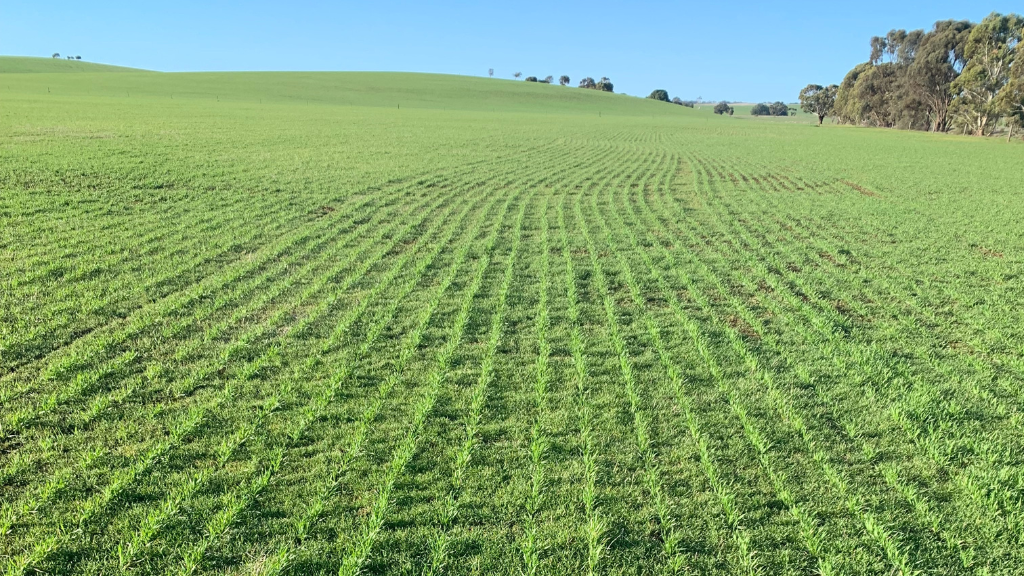
With many dry-sown crops now emerging and grass weeds such as Ryegrass, Brome Grass, Barley Grass, and Wild Oats emerging alongside of crops this year, we decided to look at nine post-emergent options that could help clean up your cereal crops.
- For targeting Ryegrass our first option is Mateno Complete by Bayer. A group 32, 15 & 12 herbicide, it’s made up of 400g/L of Aclonifen, 100g/L Pyroxasulfone (Sakura) & 66g/L Diflufenican (Brodal Options). Mateno has registration on wheat (at 1L/ha) and barley (at 750mL/ha) post-emergent. Wheat crops will need to be at least 1-leaf and barley at least 3-leaf stage before application, and a following rainfall event is ideal to wash the product to the root zone where the majority of the product is taken up. The bonus with Mateno Complete is you will also get some broadleaf weed control. Note: DO NOT use Mateno Complete if you have used Sakura/Sakura Flow as an IBS application before sowing.
- Our next option for early suppression of Ryegrass is Boxer Gold. Boxer Gold from Syngenta comprises 800g/L of Prosulfocarb and 120g/L of S-Metolachlor, both group 15’s. Boxer Gold can be used on wheat and barley post-emergent at 2.5-3L/ha. Once again, follow-up rain within 14 days is required to achieve a high level of weed suppression. Note: Once again, DO NOT use Boxer Gold if you have used it IBS before sowing.
- Our final option for suppressing Ryegrass is straight Prosulfocarb. Prosulfocarb is a group 15 in an 800g/L strength. It is registered on wheat and barley post-emergent at 3L/ha. Once again, follow-up rain within 14 days is required to move the herbicide into the soil around the shoot base and roots where it is most effective. Mild transient crop effects may occur after this application.
- For control of Brome Grass, Barley Grass, Wild Oats and Non-Clearfield Cereals in Clearfield wheats and Clearfield barleys, the go to is Intervix from BASF. Intervix is a group 2 herbicide comprising 33g/L of Imazamox and 15g/L of Imazapyr. It will give control of Brome Grass, Barley Grass, Wild Oats, any non-clearfield cereals as well as some broadleaf weeds. The label rate is 375-750mL/ha depending on weeds and rainfall/soil types with the addition 500ml/100L of Hasten. Intervix can be applied from the 3-leaf stage in wheat and 5-leaf stage in barley up until the 1st node in both crops.
- Another option to control Barley grass, Wild Oats and non-Aggressor tolerant cereals is Aggressor AX, however this is only an option in CoAXium herbicide-tolerant cereals like the new Aggressor tolerant barley Titan AX Barley, which is the only variety that has been released so far. Aggressor AX, is a Group 1 herbicide and is made up of 185g/L of Quizalofop-P-Ethyl and a crop safener. It can be used from 2-leaf up until early tillering at a rate of either 100 or 200mL/ha with the addition of Hasten at 1L/100L.
- Our next option for targeting Wild Oats and Brome Grass is Corteva’s Rexade. Rexade is a Group 2 & 4 herbicide comprising 150g/kg of Pyroxsulam & 50g/kg of Halauxifen, and a crop safener. Registered on Wheat from 3-leaf up to 1st node stage, Rexade can also give suppression on Barley grass and some broadleaf weeds. Yield is normally unaffected by treatment with Rexade, however, transient stem shortening, and crop yellowing may occur. Symptoms may be worse where the crop is stressed, heavy rain follows an application, when crops are grown in alkaline soil conditions, when the crop has poor root growth, when a double overlap of spray has occurred or a combination of any or all of the above. Where crop stress occurs, a longer period may be required for recovery, especially if the crop is stressed by root or foliar disease, poor nutrition, water logging, drought or cold stress. In severe cases and seasons where a hot, dry spring occurs, flowering may be delayed, and yield may be reduced.
- Our next option for targeting Wild Oats and suppression of Brome Grass and Barley Grass is Bayer’s Atlantis OD. Atlantis is a group 2 herbicide, made up of 30g/L of Mesosulfuron-methyl. Registered on wheat from 3-leaf, Atlantis OD will substantially reduce the growth of many weeds rather than give complete plant kill. Similar to Rexade, some crop yellowing and growth retardation may occur within five weeks of application. Growth retardation will be increased if the crop is affected by root disease e.g. cereal cyst nematode, rhizoctonia, take-all, nutritional stress, waterlogging, drought stress, excessively cold conditions or previous herbicide treatment.
- Our last two products are both Wild Oat products, the first being Axial. Axial is a group 1 herbicide made of 100g/L of Pinoxaden and a crop safener. Axial can be used in wheat and barley from 2-leaf until the first awns are visible. It has a rate range from 150-250mL/ha with the addition of 500mL Adigor per 100L of water.
- Finally, our last product to control Wild Oats is Clodinafop or ‘Topik‘. Topik is a group 1 herbicide comprising 240g/L Clodinafop-Propargyl and a crop safener. Only used in wheat from 2-leaf until late jointing. It has a rate range from 65-125mL/ha with the addition of 500mL Adigor per 100L of water.