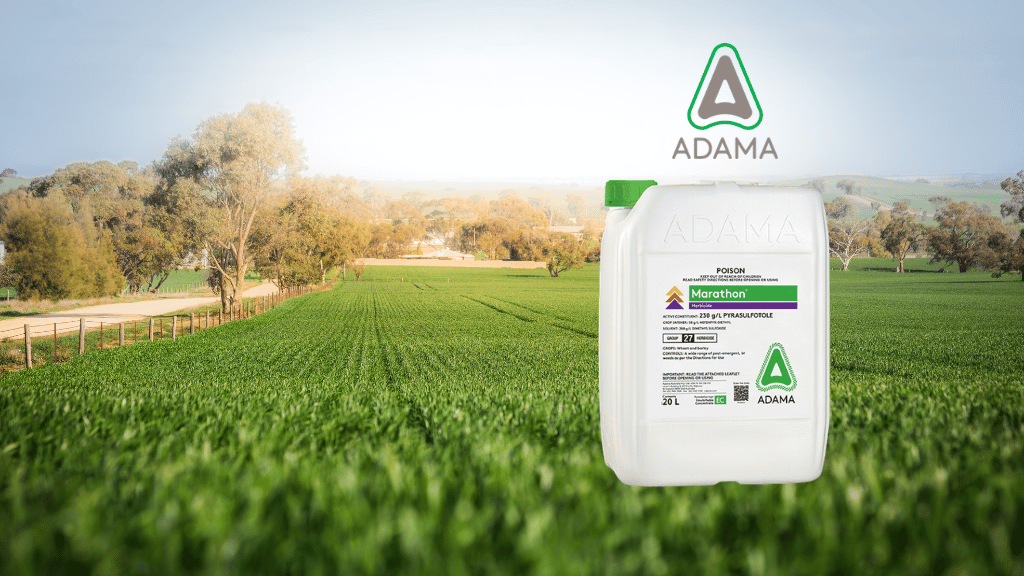
ADAMA has officially introduced Marathon®, a breakthrough herbicide designed to give Australian cereal growers a significant edge in the 2026 season.
Here’s the simple version of what it is, how it works, and where it fits.
What is Marathon?
Marathon is a Pyrasulfotole based herbicide, which a Group 27 (H) product, used to control broadleaves in wheat and barley.
You may be familiar with Pyrasulfotole, as it’s been used before in mixed products such as Velocity and Precept, and as a stand-alone active in Nufarm’s Galaxy.
It’s designed for early-season post-emergent use in wheat and barley.
In plain terms:
- It bleaches and kills weeds by shutting down pigment production
- It comes with a built-in crop safener to protect your cereals
- It’s a high-strength liquid, so easier handling and less drum movement
For an in-depth look, check out Adama’s Marathon Product Guide.
What does it control?
Marathon herbicide targets 28 broadleaf weeds, including a lot of the usual headaches:
- Wild radish
- Wild turnip
- Indian hedge mustard
- Sow thistle
- Prickly lettuce
- Paterson’s curse
- Climbing buckwheat
It’s particularly strong on Brassicaceae species (radish, turnip, mustard), which is where many other programs fall over.
Where it really stands out
1. Flexibility (this is the big one)
Marathon isn’t a locked-in premix; you can build your own mix depending on your paddock.
That means you can:
- Adjust rates based on weed pressure.
- Pick tank-mix partners to match your spectrum.
- Avoid over- or under-shooting actives.
Common mix partners include:
- Bromoxynil (e.g. Bronco 400)
- MCPA
- Quadrant / Triathlon (for added modes of action + residual)
In short: you’re not stuck with a one-size-fits-all approach.
2. Strong on resistant weeds
Because it’s a different mode of action (Group 27), Marathon is a useful tool for:
- Rotating chemistry
- Supporting resistance management
- Strengthening existing programs
3. Early application window
You can spray Marathon:
- From 2-leaf stage
- Up to GS31 (first node)
Getting in early means:
- Smaller weeds
- Better control
- Less yield drag
4. Reliable formulation
One of the knocks on some other pyrasulfotole products has been crystallisation and stability issues.
Marathon herbicide uses a newer formulation designed to:
- Stay stable in storage and transport.
- Perform across a range of hot and cold conditions.
- Reduce compatibility and mixing headaches.
A few practical tips
Keep this simple when you’re planning a pass:
- Always add AMS (1%) — it’s recommended across the board
- Use good water rates (75 L/ha+) for consistent coverage
- Oil adjuvants help on bigger or stressed weeds
- Aim for good spray coverage — this one is contact-heavy
⏱️ Rainfast is typically around 2 hours (can vary with tank mix)
Crop safety: what to expect
You might see:
- Temporary yellowing or bleaching in the crop
This is normal for Group 27 chemistry and:
- Usually shows up 2–5 weeks after spraying
- Doesn’t typically impact yield
Where it fits on farm
Marathon suits growers who:
- Want a flexible post-em option
- Are dealing with resistant or mixed broadleaf populations
- Prefer to build their own tank mixes rather than rely on premixes
- Need a reliable early-season clean-up in wheat or barley
The bottom line
Marathon is best thought of as a “mix-and-match tool” rather than a standalone silver bullet.
Used properly, it gives you:
- Strong knockdown on tough weeds
- Flexibility in your program
- Another mode of action in the shed
And in the current resistance environment, that flexibility is pretty valuable.
Marathon is in stock now at AW Vater & Co and will be available in 10L and 20L pack sizes.
Contact our agronomists today for a chat about how it can fit in your paddock.